April 2026 Updates & Notices
April 2026 Updates and Notices

Welcome to the April 2026 Updates and Notices!
Content on the InThinking IGCSE Economics website now exceeds 690 000 words. For comparison, the 320-page, Cambridge-endorsed 3rd edition IGCSE Economics textbook published by Hachette Learning (formerly Hodder Education) contains approximately 150 500 words.
In March 2026, we reached new milestones, with a record 171 teachers and 1443 students using InThinking IGCSE Economics across 32 countries.
Thank you for your continued support. 🙏
🇧🇭 🇧🇲 🇧🇷 🇨🇳 🇩🇰 🇪🇬 🇸🇻 🇪🇹 🇩🇪 🇭🇰 🇮🇳 🇮🇩 🇮🇪 🇮🇹 🇰🇪 🇱🇧 🇲🇾 🇳🇱 🇵🇭 🇵🇱 🇷🇴 🇸🇬 🇿🇦 🇪🇸🇨🇭 🇹🇼 🇹🇭 🇹🇬 🇹🇷 🇦🇪 🇬🇧 🇻🇳
Additions to the website during the past two months since our last Newsletter include:
- An infographic outlining the differences between economic goods, free goods, merit goods, and public goods has been added to Topic 1.1.3 here. These are terms that students often confuse, so the resource should help clarify the definitions and differences.
- There are two new revision posters for Topic 1.2.1 (Factors of production and their rewards)
- A new revision poster for Topic 2.4.2 (Market equilibrium) has been added here.
- Two new infographics for Topic 2.9.2 (Public and merit goods) have been added here. A common mistake is that students often confuse these terms, using them incorrectly or interchangeably.
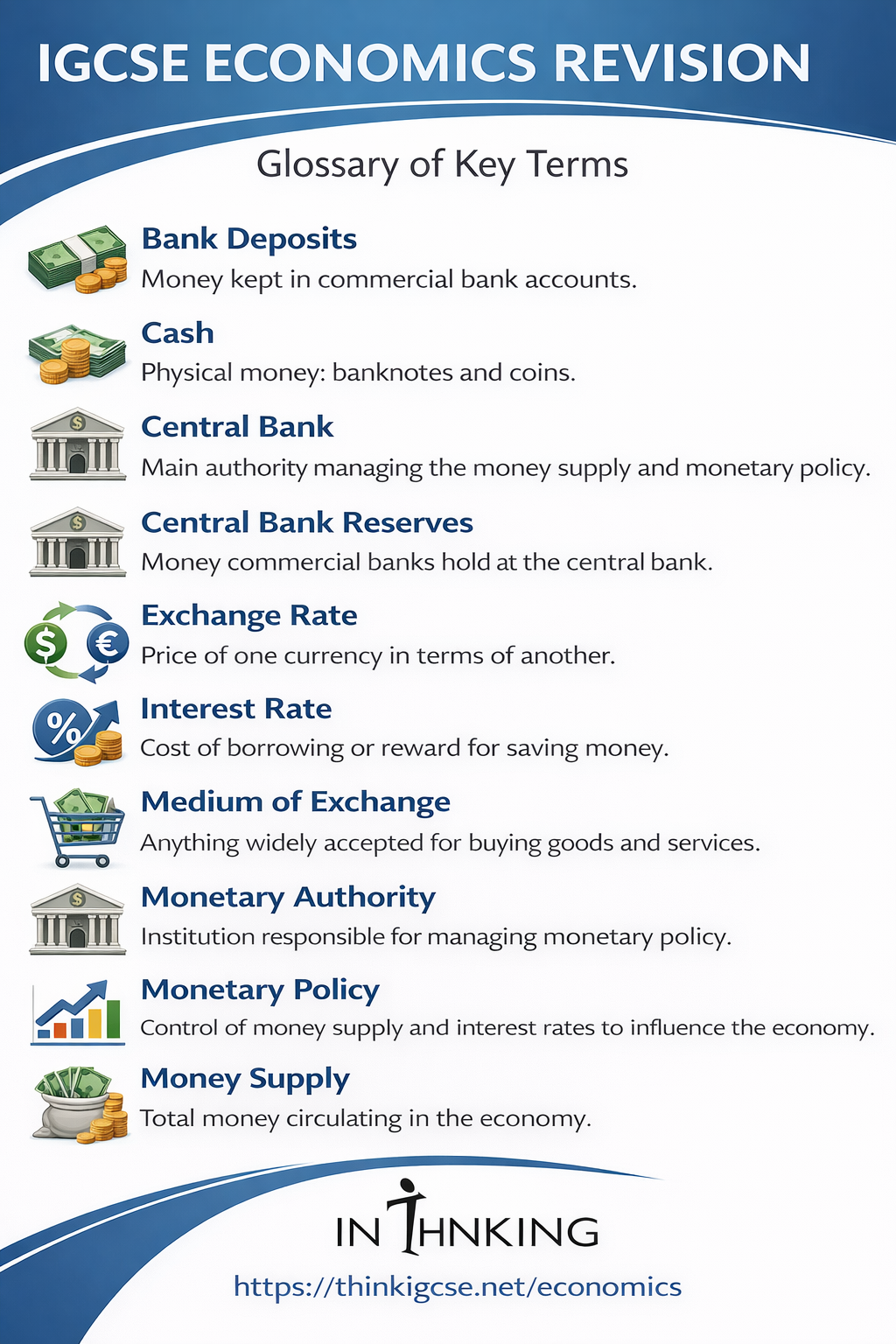
- A glossary revision poster for Topic 3.12 (Banking and money) has been uploaded here.
- A new set of Paper 2 exam practice questions has been added here for Topic 3.7.2 (Monopoly markets). The stimulus from the Financial Times encourages students to analyse the advantages and disadvantages of monopoly power held by Visa and Mastercard in the credit card payments systems market. Suggested teacher answers are also included.
- Content for the new Topic 4.2.3 (Taxation) can be found here. This section of the new syllabus contains subtle but important changes that teachers need to be aware of:
✅A 6th reason for taxation has been added: encouraging environmental sustainability.
✅A 5th stakeholder group has been introduced when analysing the impact of taxation: workers.
If you are using past resources, please take note of these updates to ensure your materials reflect the current syllabus requirements.
The updated section on the website, which includes two new revision posters, can be accessed here.
- A new revision poster outlining the differences between fiscal and monetary policies has been added here to Topic 4.3.3 for the new syllabus. Students can also access the glossary of key terms, Paper 1 worked examples, and Paper 2 exam style questions for this topic here.
- A small but important supply-side policy has been added to the new syllabus: infrastructure spending (Topic 4.4.2). This brings the total number of supply-side policy measures to seven. The updated notes and lesson activities for this section of the new syllabus can be accessed here. There is also a new interactive Quizlets to test your students' understanding of this topic.
- A new interactive True or False quiz for Topic 4.4.3 (Effects of supply-side policy measures) has been added here. This includes a sixth macroeconomic aim added to the syllabus (Effects of supply-side policy measures on environmental sustainability).
- Students can test their understanding of Topic 4.6.1 (Definition of employment, unemployment, and full employment) using these new Quizlets here. They can choose their preferred Quiz format from the drop down menu (Flashcards, Match, Learn, Test, and/or Spell).
- A set of Quizlets for Topic 4.6.3 (new syllabus) focusing on the causes (types) of unemployment can be accessed here.
- Quizlets for the new Topic 4.6.4 (Consequences of unemployment) have also been created and can be accessed here.
- To test their understanding of the contents of Topic 5.3.1 (The influences on spending, saving, and borrowing) of the IGCSE Economics syllabus, students can have a go at the new Quizlets here.
- In the new Topic 6.1.1 (Specialisation by country), a new video plus accompanying questions about China’s EV success formula (and Canada’s dilemma) can be accessed here. Suggested answers are provided in the Teacher only box. Other updates from the legacy guide for this section of the syllabus include additional worked examples for Paper 1 and Paper 2, as well as a glossary of key terms.
Student Access
Just a reminder to subscribers that your students can gain free access to InThinking IGCSE Economics! With the exams not too far away, please consider giving access to your students - it's easy to set up from the homepage.
Just a reminder that Student Access is free for all subscribing schools, with no additional cost for students to use the resources. With exams fast approaching, please consider granting access to all your IGCSE Economics students - it’s quick and easy to set up from the homepage.
To find out more about Student Access, and the benefits, click on the icon below.
There are several key functions to Student Access:
- Students have access to all notes related to the contents of the course. Essentially, they can use the website as a comprehensive e-textbook for the entire course.
- It allows students to directly access most, but not all, pages (such as examination papers and mark schemes, as well as other teacher support materials).
- It enables teachers to create tasks for their students (refer to the Smart Quizzes section of the website).
- It helps to consolidate student learning and facilitates revision (such as the Paper 1 MCQ tasks, which all come with answers that have explanations).
- It allows teachers to monitor the progress of their students using the grade book.
To get started, go to the Student Access tab in the top left corner of the home page.
The annual subscription fee has remained unchanged for the third consecutive year, offering excellent value. The website is updated weekly, all year round.
| Currency | Annual | Per week | Per day |
| USD 🇺🇸 | 270 | 5.19 | 0.74 |
| EUR 🇪🇺 | 220 | 4.23 | 0.60 |
| GBP 🇬🇧 | 210 | 4.04 | 0.58 |
At InThinking, we know that the strength and growth of our teacher community rely on word of mouth. If you’re enjoying the website, please share your experience with your colleagues and social networks. We also welcome your feedback via email to help guide the site’s future development: [email protected]
Testimonials for the InThinking IGCSE Economics website can be found here.
With best wishes for the busy month ahead,
Paul Hoang
