4. What was the impact of US involvment in Vietnam?

The Vietnam War had profound consequences for Vietnam, the surrounding countries of Cambodia and Laos and the US itself - both in terms of domestic politics and also how it would now carry out containment of communism.
Following the end of the war, Vietnam was united, but in a dire situation. The shattering impact of a ten year war with the Americans meant that both rural and urban areas were ruined, the economy shattered and the people exhausted. There were also political divisions as the North sought to impose communist rule on the South; this meant many South Vietnamese ended up in ‘re-education camps’.
Vietnam remained one of the poorest nations of the world for the twenty years following the end of the war.
In addition, there were severe environmental impacts (see below)
Many Vietnamese fled the country after it became communist; they became known as the boat people (see image above) as they sought refuge in other countries
Bombing
The U.S. military used more than 14 million tons of explosives during the Vietnam War, mostly on the South Vietnamese countryside. This transformed the forested land into crater fields. It is estimated that in South Vietnam alone, around 26 million large bomb craters (approx. 10 meters in diameter) were created by explosions. Not only did this cause destruction of the forests, but also of livestock (sometimes, as in the case of Asian elephants, believed to be helping with military transport, they were deliberately targetted). More than 100,000 water buffaloes, which are important livestock for the Vietnamese population, were killed.
Land Clearing
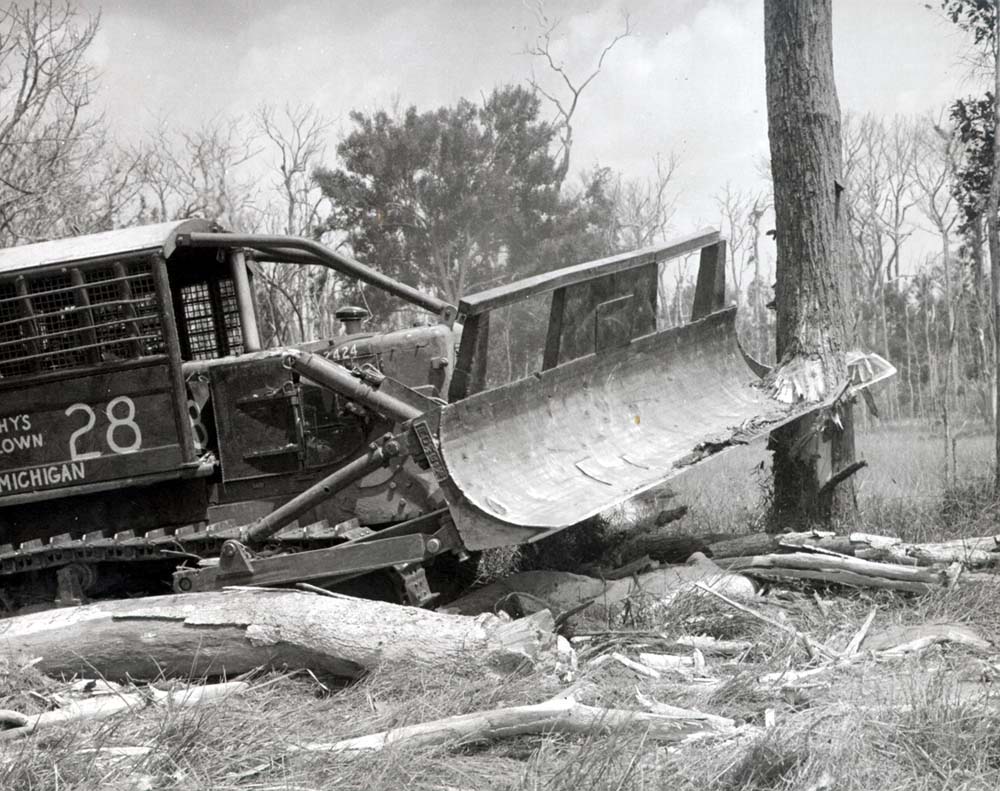
The Americans also used carried out ‘land clearing’ using big bulldozers which were were well armed against mines and could clear large areas of land very quickly. Around 200 machines were deployed in South Vietnam during the Vietnam War and cleared an area of around 325 hectares, the equivalent of around 3 percent of the land area of South Vietnam
Use of defoliants
You have already read about the use of Agent Orange. Operation Ranch Hand was launched in addition to the bombing and land clearing in order to clear the forests and thus deprive the Viet Cong of cover - allowing the US a better view of the land.
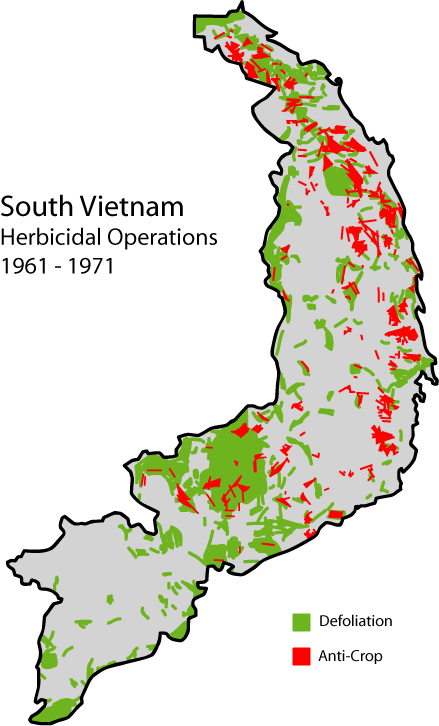
The herbicides used by the USA were sprayed on the equivalent of 12 percent of Vietnam’s total area. Projections of the area of defoliated forests and mangroves vary between 2 and 2.4 million hectares.16 In addition, there is the targeted spraying of arable land in Vietnam. The figures here are less precise and vary between 300,000 hectares and 400,000 hectares.171 A study from 2019, published in the Open Journal of Soil Science, speaks of an incredible area of around 10 million hectares.18
In addition to the well-known herbicide Agent Orange, Agent Purple, Pink, White, Green and Blue were also used. The latter was mainly used against rice fields, as Agent Blue destroyed the rice harvest within hours. In total, around 80 million liters of herbicides were used against Vietnamese ecosystems.19
https://www.ufu.de/en/the-vietnam-war-and-its-consequences-for-the-environment/
Agent Orange
Agent Orange accounts for 60 percent of the total amount of herbicides sprayed over Vietnam. In addition to destroying the environment, it is also highly toxic to humans. The dioxin remains for a long time in the environment and migrates up the food chain through cultivation (rice cultivation, fishing) of the previously sprayed areas. Thus is can enter the human body causing cancer, severe disabilities and a high miscarriage rate. These tragic problems continue to today.
A 2008 study counted 2.2 million hectares of forest that were defoliated during the Vietnam War. The destruction of so much forest in South Vietnam had long term environmental impacts with deforestation causing the rich top soil to run off during rain storms leaving barren, less fertile, soil. This also impacted birds and insects leading to a loss of biodiversity.
Carry out more research on the environmental impact of the Vietnam War; there are plenty of websites on this topic.
Produce a podcast or TV documentary on the environmental impacts of the war; bring it up to date with the situation today and how the environmental impacts have lasted. Also the legal disputes surrounding the impact of Agent Orange.
Economic impact on South Vietnam
Economic impact on North Vietnam
Another major target was the infrastructure of the North - roads and railways. These transportation routes were hit with an average of 24 bombs per kilometer. In response to these attacks the North Vietnamese government tried to minimise their impact by moving industries into the countryside, creating networks of tunnels and shelters to protect people and creating floating bridges that could be dismantled and rebuilt to avoid destruction during bombing
However, far less farming land was destroyed so the economic impact on food production was much less devastating than in the South. The main impact was the loss of men to carry out agricultural work; however these jobs were taken over by women.
The Vietnam War had a profound impact on the US. Not only did 58,000 Americans die in the war, but it left a divided country and a determination not to get involved in any other wars - 'the Vietnam Syndrome'. Meanwhile, Johnson's domestic programme of improving society for all, The Great Society, had been seriously curtailed. In addition the American economy faced inflation, a weakened dollar and increased federal deficits as a result of the war
In June 1969, Nixon issued the Nixon Doctrine:
The nations of Asia can and must increasingly shoulder the responsibility for achieving peace and progress in the area with whatever cooperation we can provide. Asian countries must seed their own destiny for if domination by the aggressor can destroy the freedom of a nation, too much dependence on a protector can eventually erode its dignity. But it is not just a matter of dignity, for ht dependence of foreign aid destroys the incentive to mobilize domestic resources - human, financial and material - in the absence of which no government is capable of dealing effectively with its problems and adversaries.
1. What does The Nixon Doctrine indicate about the impact of Vietnam on US's global policy?