Home of real teaching & learning
  • Full support for teachers
  • Focus on critical thinking
  • Engaging classroom activities
  • Integrated student eBook
  • Assessed tasks / qBank
  • Practice exam questions

The InThinking Guarantee: Our sites are written by expert practitioners and not by AI

See our AI policy

Disclaimer: InThinking subject sites are neither endorsed by nor connected with the International Baccalaureate Organisation.

Don't miss out, find out!

All Activities

Vectors and Transformations

On the other pages in this section we have divided our activities in to sub-topics. This page has them all together in one place for browsing

Congruent Halves

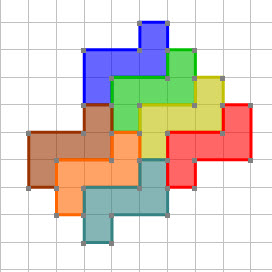
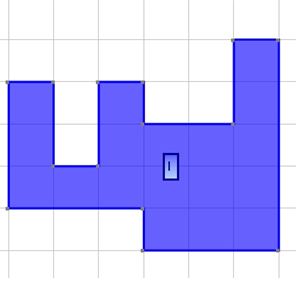
These problems are brilliant and have been around for ages. You need some real lateral thought to figure out how to divide the shapes in two such that both of the halves are congruent shapes! What is different about this activity, is that you are being asked not only to solve this bit of the problem, but to construct these shapes using technology and by drawing half of the shape and transforming it to create the other half! This will involve reflection, rotation, translation and maybe some combinations of the three. You will need to create and use mirror lines, centres of rotation and translation vectors and get the size and positions correct. You will know when you have done it because your two shapes together will make the original shape you started with. 

Brand Symmetry

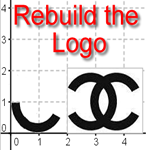
Time 1-2h: Students use their knowledge of equations of lines to rebuild well known, symmetrical logos from a small fragment of the image. They then find and/or make their own logos, providing for their partner only a small fragment (using FREE photo editors such as paint.net, gimp or others) from which to rebuild the original.

Escher Symmetry

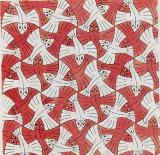
Time: 2h. Observing symmetrical objects comes quite naturally to students because we are surrounded with symmetry.  Here’s an activity that takes that skill a giant step further.  A great example of how the use of computer software can create a whole new type of activity, this investigation gets students to analyse the symmetry in Escher tiling patterns by reflecting, rotating and translating them using Geogebra. 

Geogebra is dynamic geometry software that can be downloaded for free.  For this activity it is fairly intuitive, so even students new to it will have no problems.  There is a help video provided should technical assistance be required. 

This is a great example of how beautiful images, from the Artist Escher, can provide instant engagement for students.  Scaffolding is provided to help guide students through the early parts of this investigation, and some real challenges are posed at the end where a good deal of creativity and critical thinking will be required.

Symmetry patterns like these can be described in terms of rotations or gyrations, reflections, translations, glides and glide reflections.  Apparently differently looking symmetry patterns can have the same symmetry properties and there are 17 different wallpaper groups of symmetry in total.  Six of these groups are analysed in this investigation, but, if inspired, students could be encouraged to take this further and find and describe them all.  Inspired by this work, a recent student of mine wrote a research paper about all the different symmetries.
Parking Rotations

Time 1-2 hrs: This activity gets students to investigate the effect of changing the centre of rotation. It starts with a series of fun games in which the students have to park a car in a garage by giving the correct rotations.

Rotation Navigation

Time: 1h. When describing rotations, students often forget that coordinates define a centre of rotation. Through the designing and playing of the “Around the World” and “Jungle Obstacle” games students get lots of experience of defining rotations in a fun and creative environment. The software forces students to consider angle and direction and displays the coordinates of the centre of rotation. Lots of scope for extension challenging able 14-15yr olds as a starter activity.

Rotation Reflections

Rotation Reflections & Proof

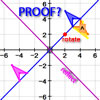
Time 1-2hrs: A really nice investigation that requires students to apply and make links between a range of topics. Can students find a single rotation that has the same effect as two reflections? Can they formulate a general theory that works given any two reflections? Can they prove it!

Equation Reflections

Time: 1-2hrs Students often think reflection is easy, but the big change at this level is the need to define, using equations, the position of the mirror line. This activity uses Geogebra and/or Autograph to explore points on different lines to remind students why lines can be defined using equations. Three further

activities oblige students to use equations to perform reflections and create a reflective, art masterpiece!

Transformation Game

Time 30 mins to 1 hr: This is a fun board game to be played in groups of 2-4. Students use cards to transform a shape and gain points according to where they land on the board. This can be used as a consolidation activity for reflections, rotations and translations. Lots of fun guaranteed!

Transformations and Tessellations

Tessellations can be wonderfully hypnotic! With some it can really quite intuitive to tell how the shapes fit together to cover the plane, but in other cases it takes a little more thought! With this activity you are asked to create tessellations by constructing one of the shapes and then repeatedly transforming it so that it covers the plane. This would be easier if you had them as cut out pieces of paper, but by using dynamic geometry, you have to think more about the mathematics involved. Are the pieces translated, reflected, rotated or some combination of the above so that they fit together without leaving any gaps! It is a simple task to explain, but not so easy to do.

Dr Who

Time: 1 hr+. This is a really absorbing and engaging puzzle that is rich with interesting mathematical behaviour. The essential learning objective for this activity is about scale factors of enlargement and repeated enlargement. The medium for the challenge really appeals and this type of dynamic question represents a whole new genre of questions that are offered by technology... 

The image of space as the backdrop and the effect of disappearing down a tunnel are really cool and makes students really want to be able to do it for themselves. To do so requires some critical mathematical thinking and problem solving. Students have to piece the observations together to make coherent explanations of what is happening and why it is happening before they can recreate it and it is here that the richness of this activity lies. I do seriously recommend that teachers try this for themselves before looking at the solution and discussion screencasts found in the teacher notes! Its great fun and an excellent challenge!

Dancing Vectors

Time 2 hrs. Introduce vectors through dancing! This is a great fun and effective activity where students imagine displacement vectors as dance moves! The vectors are combined to make a dance routine. Get the whole class up and dancing this routine to Donna Summer's hotstuff! It is a memorable experience and really helps students get to grips with this concept.

Vector Translations

Time: 1hr An introduction to the concept of vectors or for teaching translation. Students use arrow diagram vectors to reconstruct a picture and also record the vector in column format. They can then use Autograph or Geogebra to make their own challenge for a partner to reconstruct. The activity closes with a freekick, vector shoot-out applet.

All materials on this website are for the exclusive use of teachers and students at subscribing schools for the period of their subscription. Any unauthorised copying or posting of materials on other websites is an infringement of our copyright and could result in your account being blocked and legal action being taken against you.

Help