Core Probability Trees
The following are 10 onscreen quiz CORE questions to address the syllabus items:
Calculate the probability of combined events using tree diagrams
These can be set for students using student access and feedback is instant.
The probability that Sam is late for school on any day is \(\frac{1}{5}\)
Sam goes to school on Monday and Tuesday.
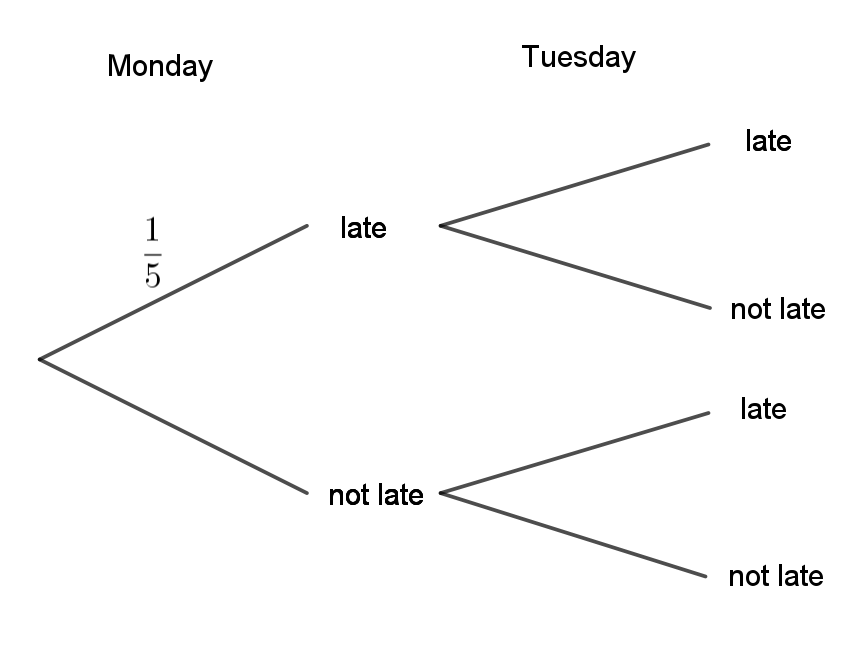
Find the probability that Sam is late on both days.
Give your answer as a fraction in the simplest form
probability = \(\frac{a}{b}\)
a =
b =
The completed tree diagram looks like this:
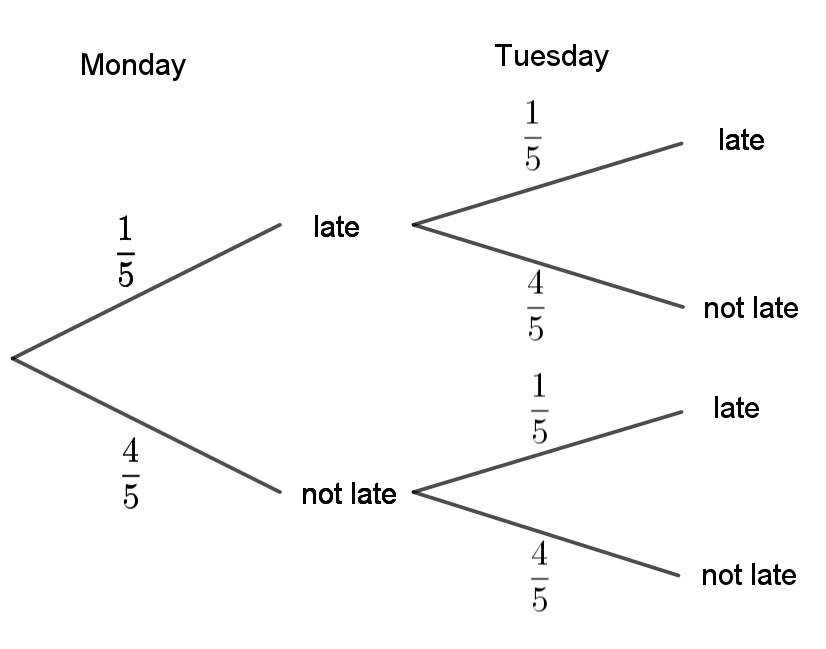
Probability = \(\frac{1}{5} \times \frac{1}{5}=\frac{1}{25}\)
A bag contains 3 red balls and 2 blue balls.
A ball is taken at random, its colour is noted, and then it is replaced.
A second ball is taken.
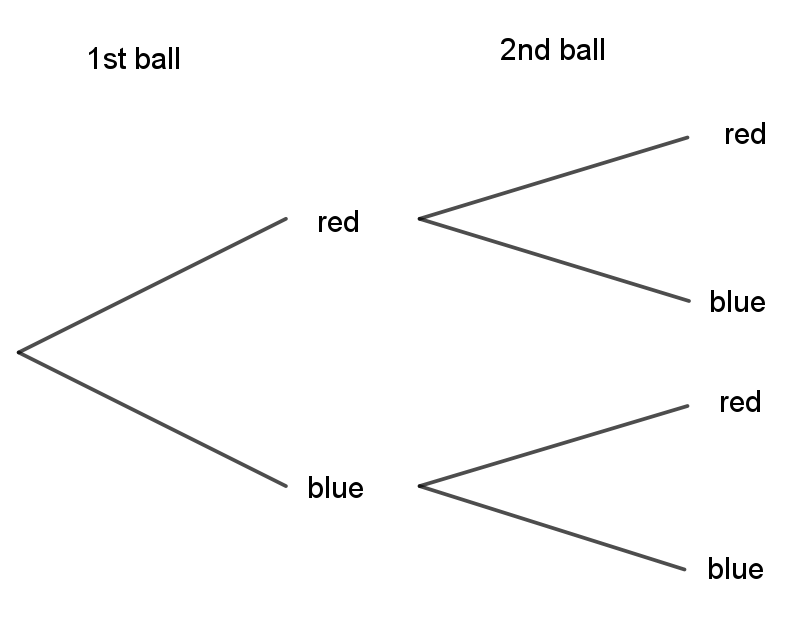
Find the probability that both balls are red.
Give your answer as a fraction in the simplest form
probability = \(\frac{a}{b}\)
a =
b =
The completed tree diagram looks like this:
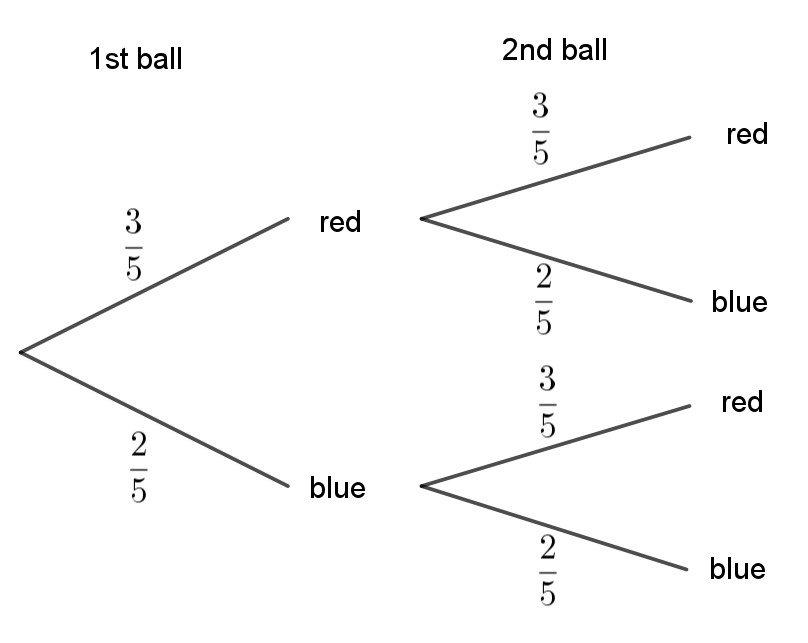
Probability of red on the first draw is \(\frac{3}{5}\)
Because the ball is replaced, the probability of red on the second draw is also \(\frac{3}{5}\)
Probability = \(\frac{3}{5} \times \frac{3}{5}=\frac{9}{25}\)
The probability that it rains on any given day is \(0.3\)
Consider two consecutive days.
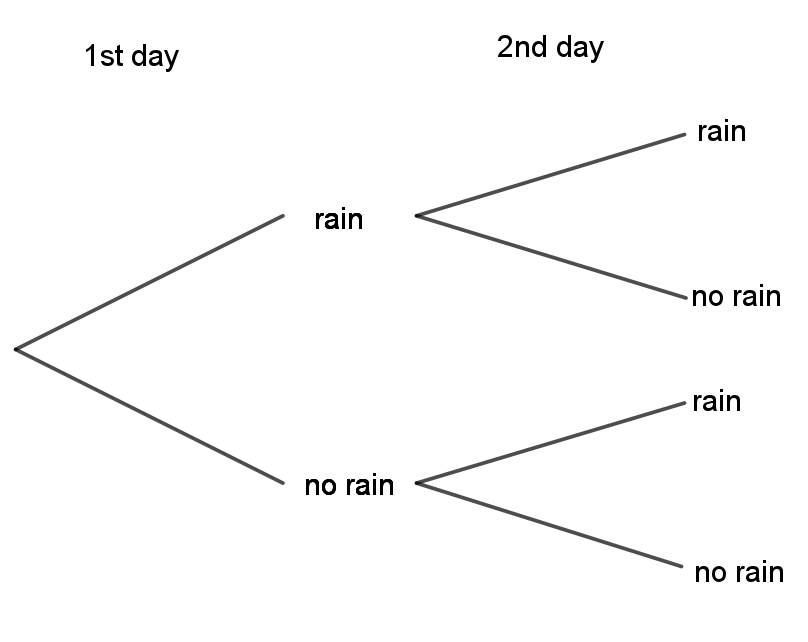
Find the probability that it rains on exactly one of the two days.
Give your answer as a decimal
probability =
The completed tree diagram looks like this:
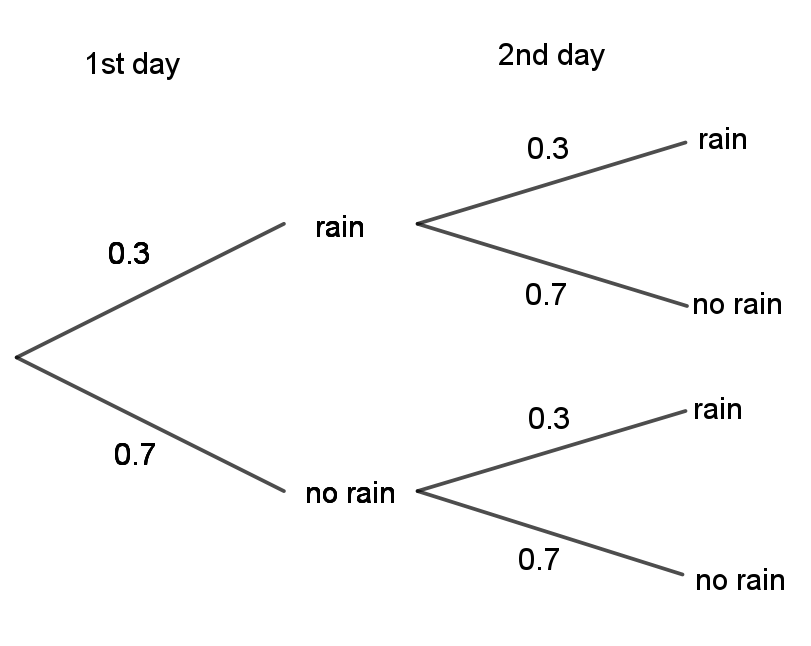
Probability of rain is 0.3 and probability of no rain is 0.7
Exactly one day of rain can happen in two ways:
Rain then no rain: 0.3 x 0.7 = 0.21
No rain then rain: 0.7 x 0.3 = 0.21
Total probability = 0.21 + 0.21 = 0.42
A bag contains 5 red balls and 3 blue balls.
A ball is taken at random and is not replaced.
A second ball is then taken.
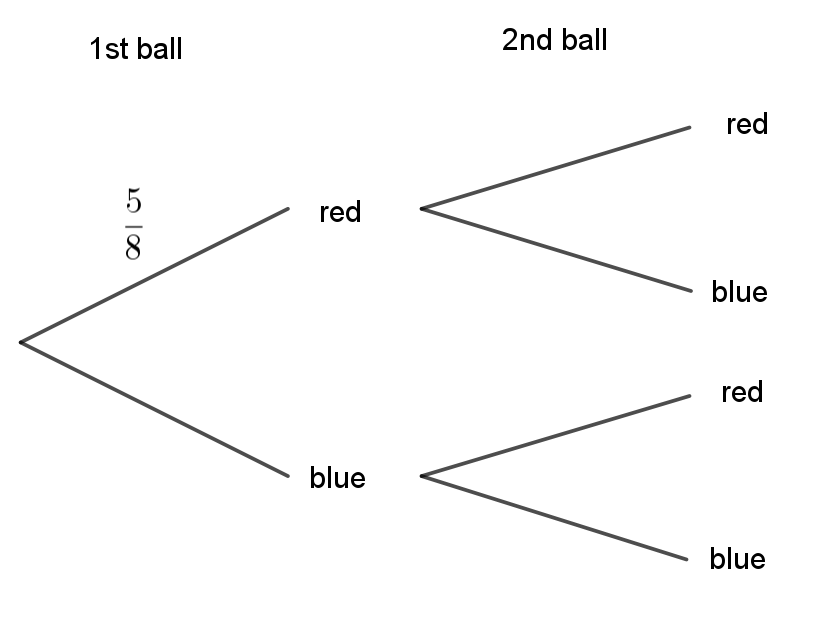
Find the probability that the first ball is red and the second ball is blue.
Give your answer as a fraction in the simplest form
probability = \(\frac{a}{b}\)
a =
b =
Probability(first red) = \(\frac{5}{8}\)
After taking a red ball, there are 4 red and 3 blue left out of 7.
Probability(second blue given first red) = \(\frac{3}{7}\)
The completed tree diagram looks like this:
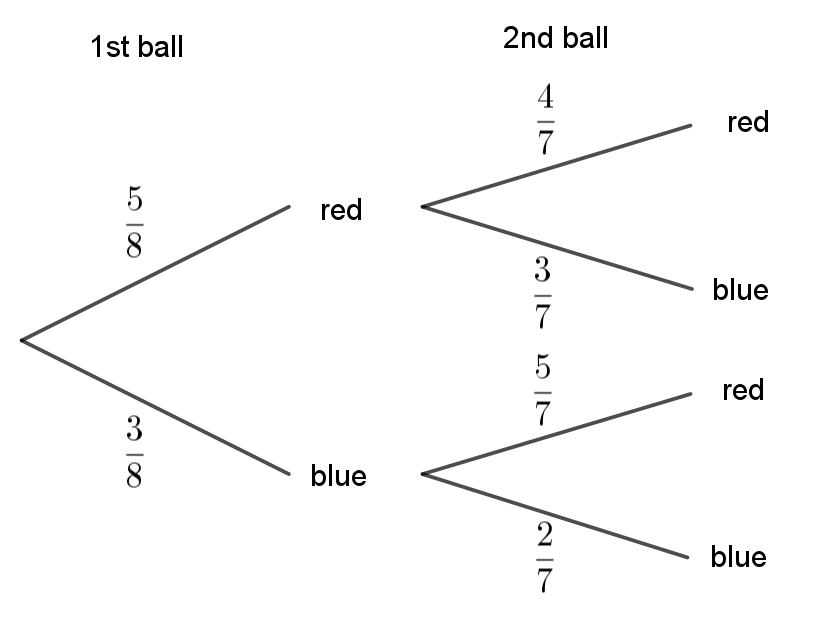
Probability = \(\frac{5}{8} \times \frac{3}{7}=\frac{15}{56}\)
The probability that a seed produces flowers is \(0.8\)
If flowers are produced, the probability that they are red is \(0.6\) and the probability that they are yellow is \(0.3\)
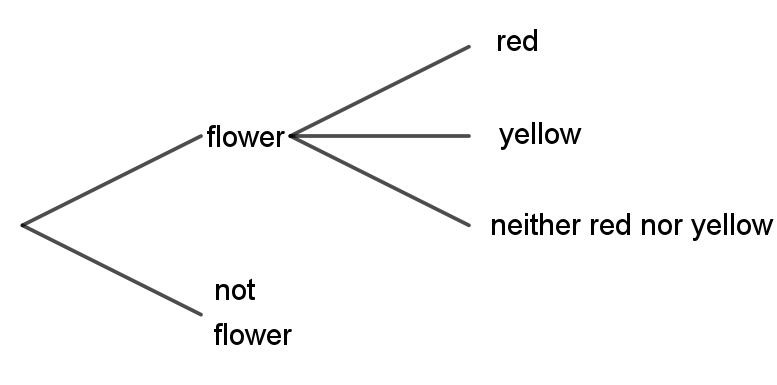
Find the probability that a seed produces flowers that are neither red nor yellow.
Give your answer as a decimal
probability =
If flowers are produced, probability(neither red nor yellow) = \(1-0.6-0.3=0.1\)
The completed tree diagram looks like this:
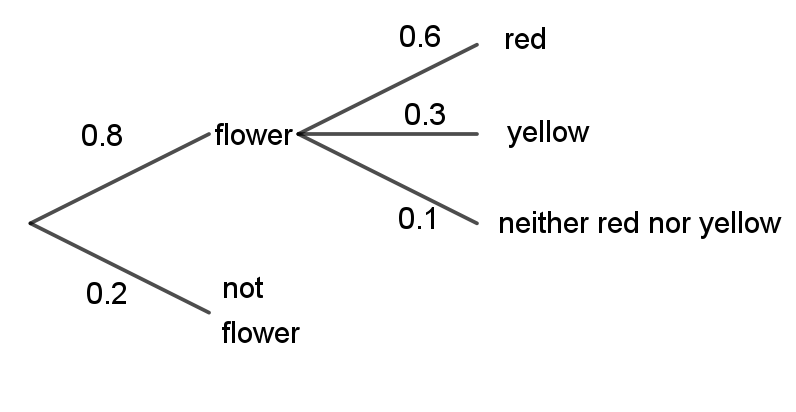
So probability(seed produces flowers that are neither red nor yellow) = \(0.8\times0.1=0.08\)
On any Saturday, the probability that Arun plays football is \(\frac{3}{4}\)
On any Saturday, the probability that Bob plays football is \(\frac{2}{5}\)
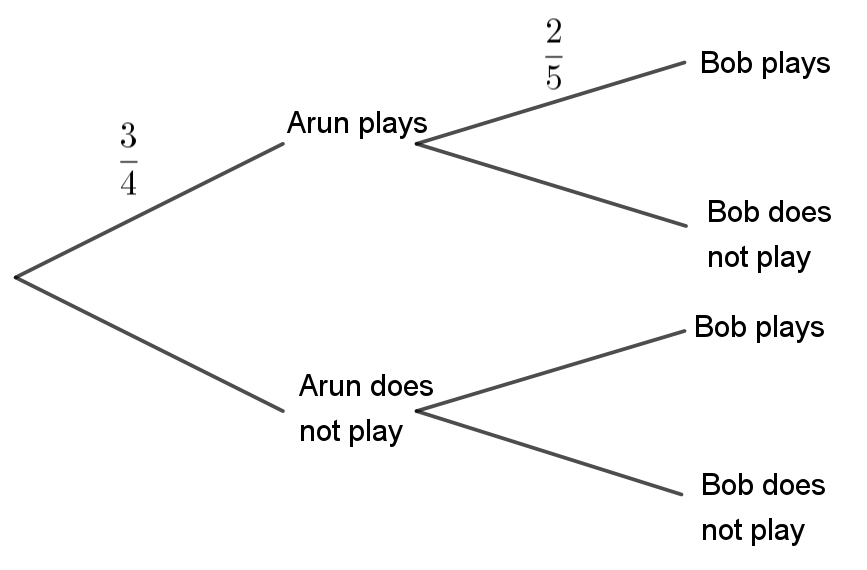
Find the probability that exactly one of Arun or Bob plays football on a Saturday.
Give your answer as a fraction in the simplest form
probability = \(\frac{a}{b}\)
a =
b =
The completed tree diagram looks like this:
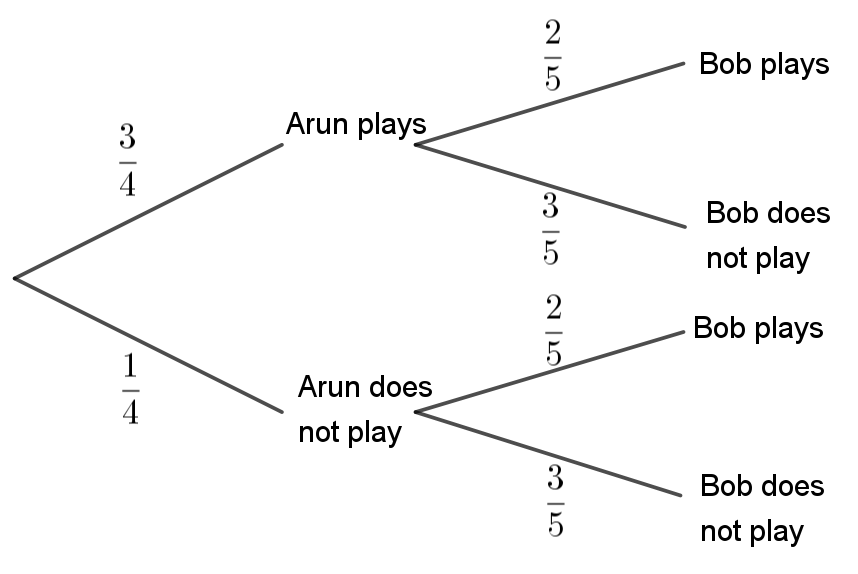
The event can happen in two ways:
Arun plays and Bob does not play: \(\frac{3}{4}\times\frac{3}{5}=\frac{9}{20}\)
Arun does not play and Bob plays: \(\frac{1}{4}\times\frac{2}{5}=\frac{2}{20}\)
Total probability = \(\frac{9}{20}+\frac{2}{20}=\frac{11}{20}\)
A biased coin has a probability of \(0.7\) of landing heads.
The coin is tossed three times.
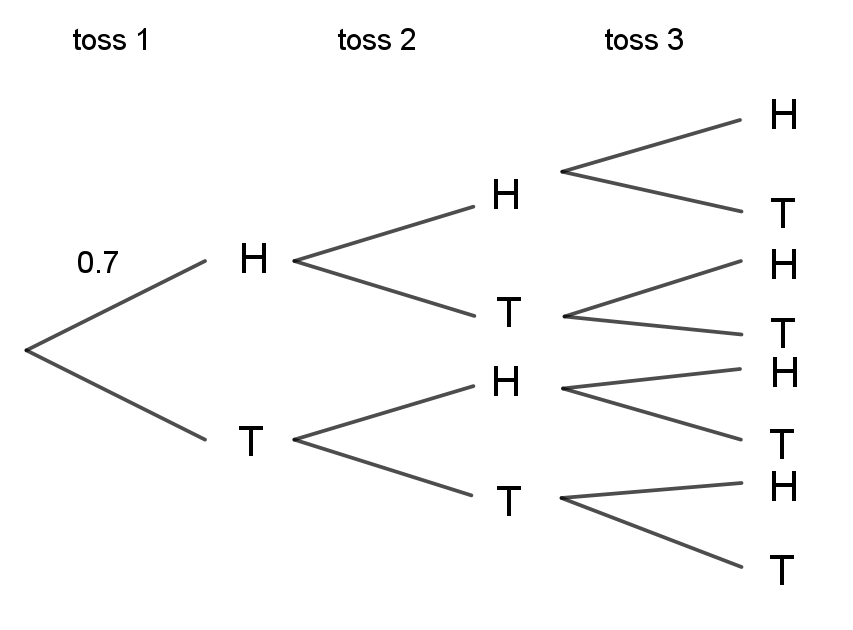
Find the probability that the coin lands heads at least once.
Give your answer as a decimal
probability =
It is easier to find the probability of no heads (all tails) and subtract from 1.
Probability(tails) = \(1-0.7=0.3=\frac{3}{10}\)
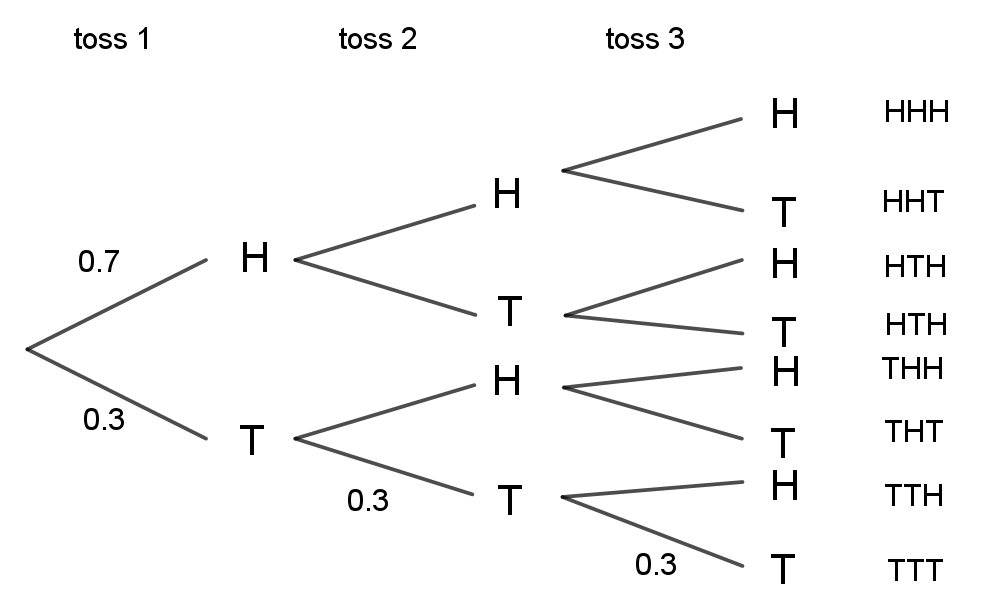
Probability(all tails) = \(\left(\frac{3}{10}\right)^3=\frac{27}{1000}\)
Probability(at least one head) = \(1-\frac{27}{1000}=\frac{973}{1000}\)
A box contains 4 green counters and 6 yellow counters.
Two counters are taken one at a time without replacement.
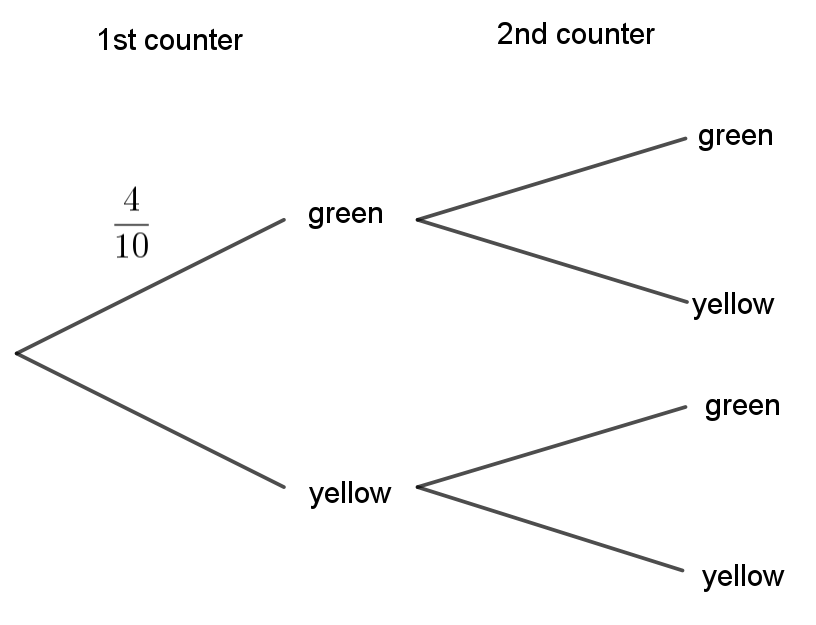
Find the probability that at least one of the counters is green.
Give your answer as a fraction in the simplest form
probability = \(\frac{a}{b}\)
a =
b =
The completed tree diagram looks like this:
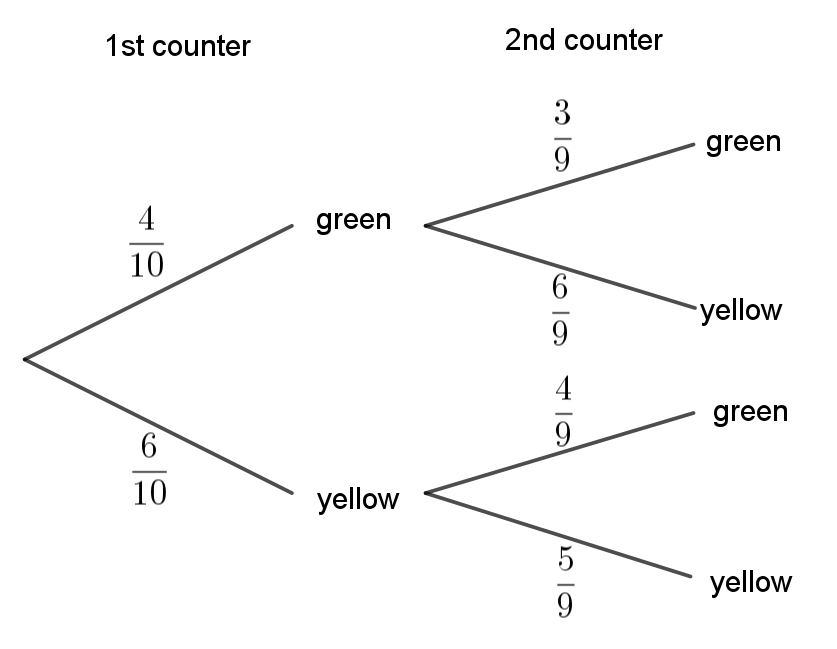
It is easier to find the probability of no green counters (both yellow) and subtract from 1.
Probability(first yellow) = \(\frac{6}{10}=\frac{3}{5}\)
Without replacement, probability(second yellow given first yellow) = \(\frac{5}{9}\)
Probability(both yellow) = \(\frac{3}{5}\times\frac{5}{9}=\frac{15}{45}=\frac{1}{3}\)
Probability(at least one green) = \(1-\frac{1}{3}=\frac{2}{3}\)
A machine produces items.
The probability that an item is faulty is \(0.1\)
If an item is faulty, the probability that it is detected by inspection is \(0.8\)
If an item is not faulty, the probability that it is incorrectly identified as faulty is \(0.05\)
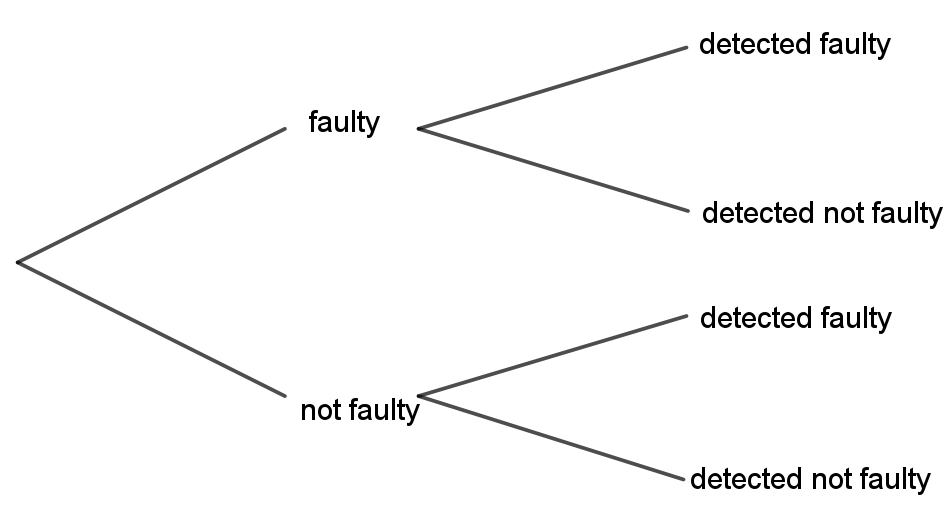
Find the probability that a randomly chosen item is rejected by inspection.
Give your answer as a decimal
probability =
The completed tree diagram looks like this:
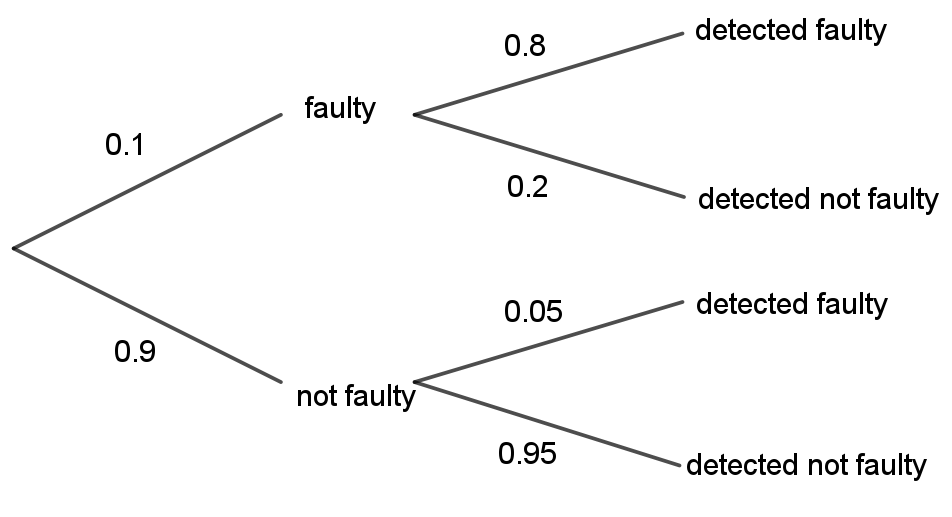
An item is rejected if it is faulty and detected, or not faulty but incorrectly identified as faulty.
Probability(faulty and detected) = \(0.1\times0.8=0.08\)
Probability(not faulty and incorrectly rejected) = \(0.9\times0.05=0.045\)
Total probability rejected = \(0.08+0.045=0.125\)
A student answers two questions.
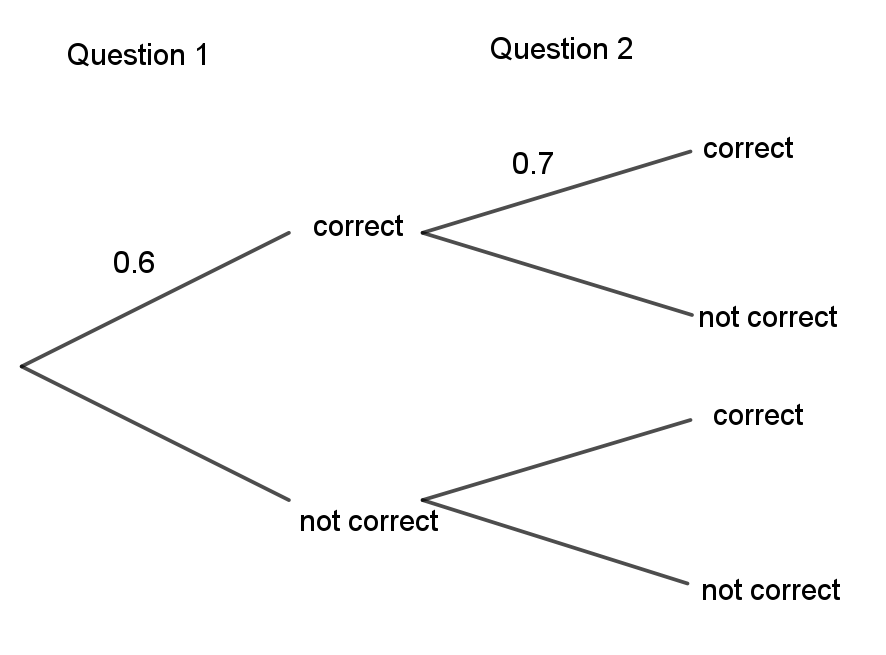
For Question 1, the probability of a correct answer is \(0.6\)
If the student answers Question 1 correctly, the probability of answering Question 2 correctly is \(0.7\)
If the student answers Question 1 incorrectly, the probability of answering Question 2 correctly is \(0.4\)
Find the probability that the student answers exactly one question correctly.
Give your answer as a decimal
probability =
The completed tree diagram looks like this:
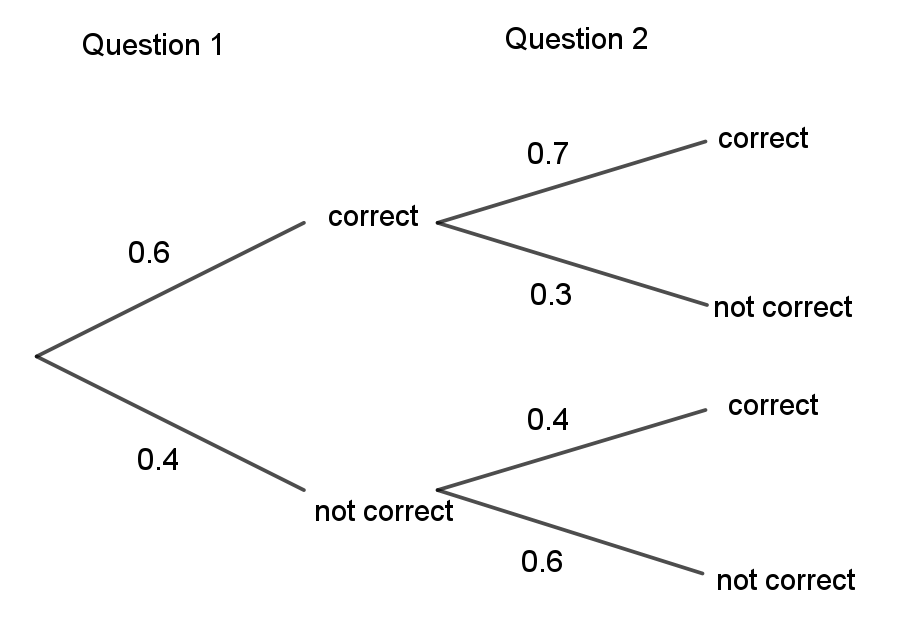
Exactly one correct can happen in two ways:
Correct then incorrect: \(0.6\times(1-0.7)=0.6\times0.3=0.18\)
Incorrect then correct: \((1-0.6)\times0.4=0.4\times0.4=0.16\)
Total probability = \(0.18+0.16=0.34\)